Friday, November 27, 2009

Touring the North Island

I left Japan a little more than a week ago and now I am writing from a friend's apartment in Brooklyn, New York. So many places I have visited the last few days! It started with a cheap JetStar flight from Kansai Airport, via Gold Coast, Australia to Auckland. It was a bit nostalgic to visit the "city of sails" again. On my second day in New Zealand I rented a car and drove up to Whangarei. I made a little detour to look at the Kauri Museum and the Waipoua Kauri Forest, so instead of three hours the trip took all day and I arrived really late. I stayed two nights on Søren Larsen. Interesting feeling to be back and see the ship where I left her. I was back in my work clothes, taking down awnings, fastening deck equipment and building an outboard engine bracket. Was Malaysia and Japan just a dream? Did I ever leave Whangarei and New Zealand?


Log from the Kauri Museum in Matakohe. This was my first stop on the second day in New Zealand, a couple of hours from Auckland. Today very little is left of the great kauri forests that once covered large areas of New Zealand. Look at the size of that chain saw blade!


Kauri was not only appreciated for its timber, but also for the kauri gum, which is a bit similar to amber. Big lumps, lots of them!


The planks obtained can be quite big. Such as the one used for the table here. Kauri was one of the preferred woods for Maori carvings and canoe building.


I continued north from the museum in my little rental car.


The scenery of the Northland district is just amazing. As sceneries usually are in New Zealand.


I forgot the name of the funny looking, very symmetrical pine trees they have here. But I love them.


West coast sea view.


The weather was dramatic on this day.


Guess the main wind direction...
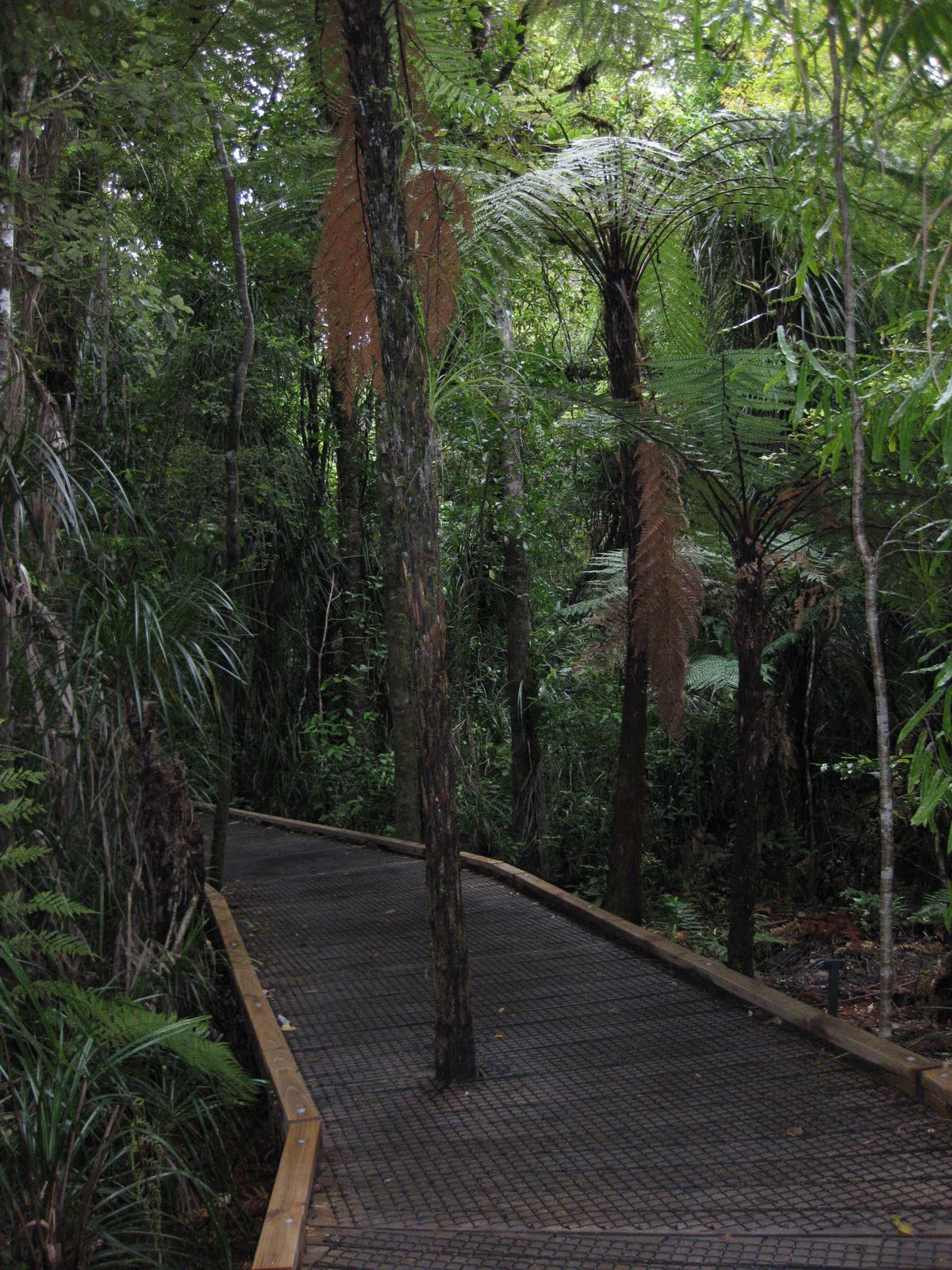


Finally I arrived in the Waipoua Kauri forest. A decked pathway led into the jungle-like vegetation.

First I went to see the biggest Kauri tree still alive, the Tane Mahuta or Lord of the Forest. The path made a sharp turn and the first thing I saw was a sign, starting with the words "You are in the presence of one of the most ancient of trees..." I looked up and there it was. Awe.


This is Te Matua Ngahere, with the largest trunk diameter of any living Kauri tree. (The largest kauri trunk ever recorded was actually twice as thick.)


"Three Sisters", three large-medium sized Kauri trees standing close together. Notice the size of the man down to the left in the picture.


Me in front of a kauri tree.
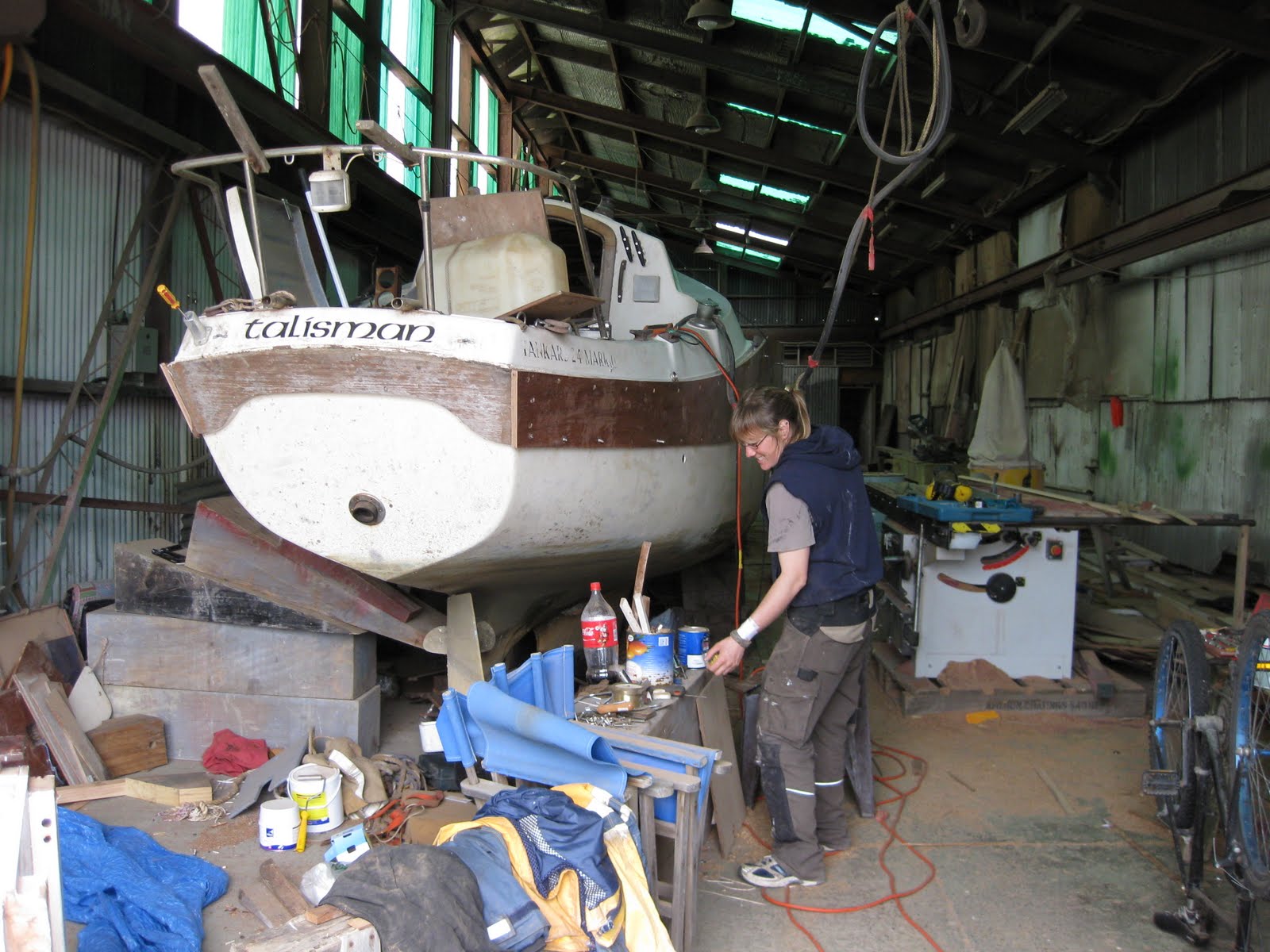


It was already getting dark when I left Waipoua. I arrived in Whangarei maybe an hour before midnight. My first stop was our old spar shed right inside the main gates of NZ Yachts. Cubie and Jarren were here, burning the midnight oil on their new project which they bought a while ago.


Søren Larsen was looking really good in the lovely spring weather.


The new deckhouse is very similar to the one that was demolished by the wave. Only newer.


She was scheduled to sail the following Monday so there were jobs going on everywhere.


Even Jarren was working.


A lot of new names onboard.


The local seagulls didn't seem to worry much about the chaos.


We had a BBQ on Saturday evening.


Spirit of New Zealand was up the slip not too far from us.


And a couple of crew from Spirit of New Zealand joined the party. Here their captain is talking to Steve, the owner of Søren Larsen.


Gathered in front of a campfire on the "beach" after the BBQ, just like the night before I left the ship in March.


And we burned the old deck of the Talisman, Jarren and Cubie's boat.

I left New Zealand on Sunday evening and I arrived in Los Angeles in the morning of the same day. Finally I got that day back, which I lost when I crossed the date line westbound a year ago!

Sunday, November 22, 2009

Kyoto eye candy and relativistic near-light speed travel

I have arrived in LA and bargained for a cheap hotel room with free WiFi. I left New Zealand at 7pm today and when I checked in to my hotel it was around noon. (Nope, no relativistic near-light speed travel, just that funny things happen with the dates when you cross the date line.) More blog posts will come soon about NZ and USA, but let us first return briefly to Kyoto.

A couple of weeks ago, I had the opportunity to meet Mr. Kashima, a craftsman who works with the traditional art of painting family crests on Kimono. I was introduced to him by Mr. Matsuishi, my Japanese teacher. Kyoto has a lot of traditions and many old skills have been preserved here, particularly from the trade of kimono making. A formal kimono has the owner's family crest painted on both sides of the chest, in the neck and on both sleeves. The job is done by hand with Chinese ink and a thin brush. It is an incredible precision job which takes many years of apprenticeship to learn. No room for mistakes, kimono silk is expensive!


Kashima showing different designs of family crests.


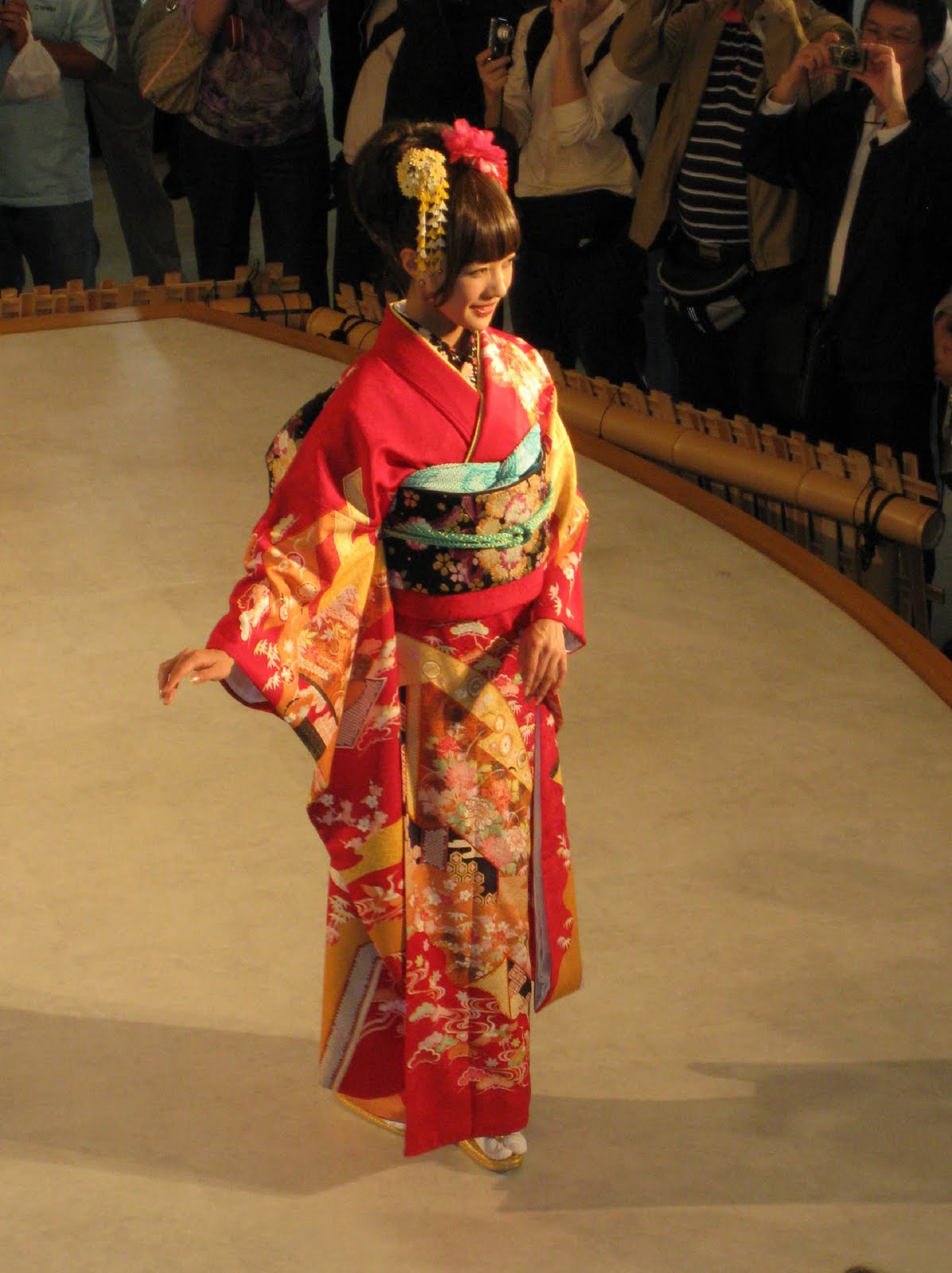
There happened to be a kimono show in the building where I met Kashima. Here is some eye candy from that occasion.


Some kimono have long sleeves called "furisode". These are mainly worn by young unmarried women.


Note that two of the spectators in the background are also wearing kimono!


This picture is from the imperial palace grounds. These are clothes for the court nobles and they are of a much older and more elaborate type than the kimono above. During the Heian perioid (794 - 1185), a glimpse of the twelve layers of a court lady's sleeves, with its beautiful color composition, could be enough to put the hearts of young noblemen on fire.


Another great opportunity to see some really old fashioned Japanese clothing is the Jidai Matsuri, which translates as the "festival of the eras" or the "festival of ancientness". Despite its name, this event doesn't not have as ancient traditions as many other festivals in Kyoto. It was established in 1895, to commemorate Kyoto's thousand years as the capital of Japan after the emperor had moved to Tokyo. It is basically a historical reenactment festival, where thousands of Kyotoites parade on the streets in costumes from different periods between 794 and 1868.


People lined up in front of the Heian Shrine during the Jidai Matsuri.

Thursday, November 19, 2009

Kōyō overload in Sennen no Miyako


Kōyō, as we learned in the last blog post, refers to the color of autumn leaves. Sennen no Miyako means “the 1000-year capital” and it is a nickname for Kyoto. The city was established as the Imperial capital in 794 and, although the de-facto power center shifted over the centuries, Kyoto remained the home of the imperial family until the Meiji restoration in 1868. If you ask some modern day Kyotoites, this is still the true home town of the Emperor and capital of Japan. People from other parts of the country are sometimes referred to as being “from the countryside”. It does not matter if they are from Tokyo, a megacity which totally dwarfs the little rural 1.5-million people town of Kyoto.


The Imperial palace grounds were open to the public a couple of days this month. It is a vast park area with beautiful buildings sprawling all over. A little while before closing hour on the last open day, I was finally able to drag myself over there, a five-minute ride on my bike.


Japan is one of very few countries in the world that does not have an official national emblem. Instead the Chrysanthemum Crest is used, which is properly the family crest of the Imperial family. The gable ends of the Imperial palace grounds were totally cluttered with chrysanthemums.


I love the well balanced unruliness of Japanese architecture!


The gardens were so incredibly beautiful... Just a bit difficult to catch it in a two-dimensional photograph. Kōyō in the background.


Glimpse of kōyō


Big kōyō.

Wednesday, November 18, 2009

Sayonara

Writing these lines on Wednesday afternoon, on the Shinkansen (”Bullet Train”) from Kitakyushu to Kansai Airport. I have been visiting my relatives one last time. Went to see grandma, she was tired but seemed to remember me pretty well this time. I also had lunch with my aunt and a dinner with my uncle and Seigo and his wife. Really sad to leave Japan now. I could stay here another half a year. Or longer.

Leaving Kyoto yesterday was not very easy either. I am really going to miss that town and all the friends I have made there. I actually got delayed one day (this is becoming a bad habit…), but this time alcohol was not involved. Not directly anyway. The schedule was a bit tight on Monday when I went to pick up my bike, which I had left downtown on Saturday night. When I arrived it was stolen! I tried to report it to the police but realized that the culprits were most likely not thieves, but rather traffic wardens who had taken it into custody for being left in a no-parking zone. Anyway, I got delayed, missed the cheap night ferry to Kyushu, had to spend another night in Kyoto and took the shit-expensive early morning shinkansen instead.


Life in Sakura apartment has sometimes been a bit intense. On Saturday we were able to squeeze in two parties in one single day. This picture is from the preparations for the lunch. Dude with his hands in his pockets is our super cool landlord, Norimasa “Nori” Ida. He bought foodstuff and his parents showed up to teach how to cook the best Japanese cuisine ever.


Table is prepared and we are just waiting for the guests.


This is where there should be a picture from the party in the evening, but my camera battery ran flat.
We had a record number of people squeezed in to our living room and Laura and Enrico fixed a beautiful chili con carne. Best goodbye-party imaginable. I even went to bed well before sunrise this time, just a little bit tipsy.


The next goodbye party was in Kyushu, on Tuesday evening. Seigo, me, Shojiro, Seigo’s wife. And a ton of incredible seafood. We had fugu (blowfish), scallops, a dozen different fishes, sea urchins, basically everything I had ever heard of and a lot more. Most of it was served as sashimi (raw) and we also had a nabe (stew). Thanks Shojiro, gochisousama!


I have heard about fish served alive but this was the first time I saw anything like it in real life. This lobster was still trying to move as well as he could on his bed of vegetables and seaweed. All the meat from the tail had been scraped out and was served as little piles of sashimi on the plate beside him. I was glad I had had a few stiff drinks before I dug into this one.


Moon over Shin-Mōji harbor. This was taken as I arrived in Kyushu on my trip in October, when I was actually able to get in time for the ferry.


At that time I went to see Kokura Castle with Yumiko and Yuji, my aunt and my cousin.


The authorities of Kitakyushu had come up with a very inventive and efficient way to fight graffiti. They banned it! Only in Japan...


Kyushu hills seen thru morning mist. Another shot from the early morning arrival in Shin-Mōji.

Sunday, November 8, 2009

This is the way a blog should be


Went on a trip today to Miyama and after returning to Kyoto we continued to Nijo Castle. And here are the pics! This is the way a blog should be maintained, pics uploaded on the day.

The entire thing was basically a treat from Nori, our landlord. What we payed probably covered half his costs for the day. Thanx Nori! Sakura rocks!


Enrico and Justin enjoying the view over the Kitamura village in Miyama and it's super traditional Japanese mountain houses. The steep angle of the thatched roofs is there to make the snow slide off. The plant used for thatching the roofs is called Kaya in Japanese. The kaya is gathered in the fields around the village and smoked to prevent rot and mold.


This obaasan showed the traditional way of beating the crap out of dried edamame beans. Apparently it has something to do with cooking and food.


Okapi also enjoyed the trip! Our always so friendly Sakura house manager.


We went to a little museum with pretty interesting collections and free tea. I found this knife. Love it and need to make something similar after getting back to Sweden!


Yup, it is flowers. In November. I am not sure if I want to go back to the Swedish winter darkness after all...


Back in Kyoto we went to Nijou-jou, aka Nijo Castle. Rather than a castle it is a compound of parks and palace-like mansion buildings. Nijou-jou was built in the early seventeenth century by the Tokugawa shoguns as their residence when they visited the imperial capital. This is a view over the Honmaru palace in the inner parts of the compound.


Okapi, Nori, Brian and Enrico. This is basically what the entire day was like.


I remember sitting on Tioman Island in Malaysia in August, studying Japanese and wondering what kind of silly textbook I had, including words like "kouyou" in the vocabulary lists. The translation of kouyou said "red leaves; autumn tints". Is it not a little over the top to teach words that specific? How often do you use that in daily conversation? Fact is that I keep hearing it all the time in Kyoto right now. Guess all languages have some parts of their store of words that are unique but still hold a central position in the culture. Does English have any equivalents to Swedish "skarsnö" (soft snow covered by a layer of harder snow crust, caused by temperatures varying around the melting point) or "tjäle" (subzero earth temperature, causing the ground to freeze and become rock hard)? Does any other language than English have like a gazillion different words for weed? Anyway, kouyou-season has started in Kyoto now.


The entrance to the Ninomaru Palace. The building is well preserved and has stunning interiors. Absolutely marvelous wood carvings and wall paintings. The hallways are built with "nightingale floors", that actually sound like birds singing when you walk on them. It was a way to prevent ninjas, talibans, and other unruly Kyotoites to sneak up on the Shogun and his guests.


This part of the garden was totally breathtaking. Unreal. And on a computer screen it is just some nice but two-dimensional trees...


What is a castle without a moat? Nijou-jou has two (concentric).

Tuesday, October 27, 2009

Interesting stuff from Japanese construction sites

Throughout the centuries, and still today, there has been a lot of interesting stuff going on at Japanese construction sites. Here is a bunch of pictures reflecting that. Eclectic madness. Low-key perfection and tacky exaggerations.


When I visited Kyoto in the late summer of 1997, the new station building had been finished earlier the same year and it was profoundly hated by many Kyotoites. Sometimes it takes a bit of perspective to appreciate what is good... This picture is taken from a part of the building that gives the impression of an artificial hill, fifteen stories high.


A thing of great beauty. And I used to hate glass facades. (Kyoto Station again, mirroring itself and the surrounding city.)


Kinkakuji, the golden pavilion temple. Not exactly the kind of aesthetic ideal that first comes to mind when you think of of the strict asceticism of Zen Buddhism. But it is really not to different from many other of these temples, only this time they covered it in 0.5 μm of pure gold.


The Osanbashi ferry terminal in Yokohama. I didn't get any pictures that could do this place justice, but it is well worth a visit. A fascinating and innovative approach to this kind of public space. And probably awesome for skateboarding.


One of the buildings at the Zuiganji temple in Takamatsu. Zuiganji is very famous but I do not think this particular house is. Just beautiful proportions and a nice example of the typical blurring of interior and exterior.


When talking about architecture and art, the gardens are not to be missed. This is the famous rock garden of the Ryoan-ji temple in Kyoto. The peak of Zen aesthetics.


Alright, this is a slight deviation from today's topic. But when the sign says rock garden, you just have to strike a pose, right? Imagine what could be done in those Zen gardens with some electric guitars and maybe a couple of off-road bikes...


Todaiji temple in Nara, founded in the eighth century. Wikipedia says it is the largest wooden building in the world. Today's temple is a reconstruction made in the eighteenth century after a fire, 30 percent smaller than the original.


Interior from Todaiji. It is pretty massive.


It is a carrot! No, it is golden poo! An architectural Rorschach test. Asakusa, Tokyo.


Typical Japanese street. Third World Chic, with power lines all over.


Another typical Tokyo street. Some of the houses are so thin. How can they fit anything useful into the floors of those bonsai skyscrapers?


National Art Center in Tokyo